
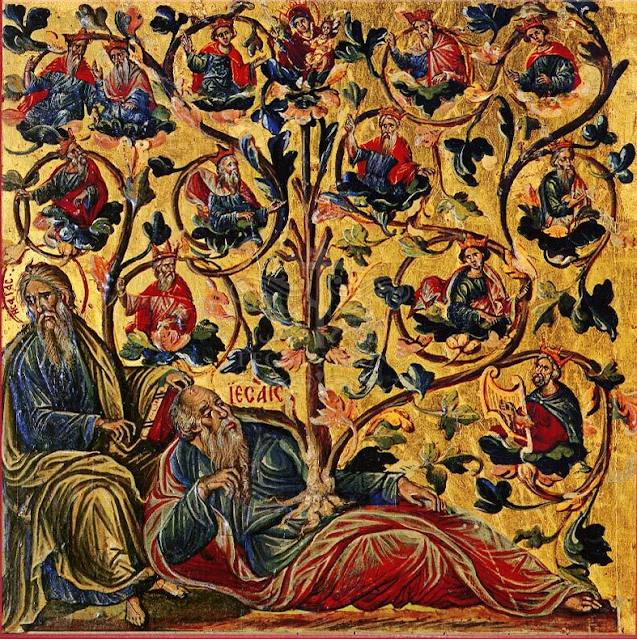
A Jesse Tree icon based on Isaiah: "On that day, the root of Jesse will be a sign for all nations. The Gentiles will look to him, and his home will be glorious." (Isaiah 11:10)
The History of Advent
This Sunday, Christians around the world will begin a new liturgical year with the season of Advent. As a season in the church calendar, Advent was not part of the Church’s earliest calendar. For the first few centuries, Christians simply gathered around Easter and the weekly Lord’s Day, and it was not until the 4th century that December 25 even appeared as a feast day to recognize Christ’s birth. Only gradually did a season of preparation grow around it that we now call Advent, bringing together practices from different regions like Gaul (modern-day France), Spain, and Rome. Each region had differing liturgies, with some more penitential and others more festive, but they slowly came together to form what we now celebrate with the four Sundays leading up to Christmas.
The Meaning of Advent
The word Advent comes from the Latin adventus, meaning “coming” or “arrival.” It is a season of remembering and preparing for Christ’s two comings. Our Old Testament readings this season will remind us of Israel waiting in darkness for the Messiah to come as the Light of the world. And our New Testament readings will remind us that because Christ has already come once in great humility, we are to prepare for the day when he will come again in great glory to judge the living and the dead. Advent holds together grace and judgment, longing and fulfillment, and the already and the not yet.
The Challenge of Advent
Our cultural practices tend to push us, as believers, to sprint toward December with feasting, celebrating, and consuming, often without pausing to watch, wait, or make room for the Light who comes. One historic Christian practice of Advent has us begin with reflecting on the world's darkness and the darkness of our own hearts (“give us grace to cast away the works of darkness” BCP, First Sunday in Advent Collect), which trains us not only in fresh repentance but in how to wait more patiently for the Light to come. This posture of Advent makes our Christmas rejoicing fuller, more rooted, deeper, and more whole. If Advent is unfamiliar to you, the resources below offer an entry into its rhythms. May the Spirit of the Messiah consecrate this season for you, making it both holy and joyful.
Advent Books
If you are new to Advent, or simply seeking fresh reading as we begin this new liturgical year, we commend the following books to enrich your reflection and prayer:
Advent Homilies: by St. Augustine
Waiting on the Word: A Poem A Day for Advent, Christmas, and Epiphany by Malcolm Guite.
Sermons on Advent & Christmas by St. Bernard of Clairvaux
Advent: The Once and Future Coming of Jesus Christ by Fleming Rutledge
God is in the Manger: Advent & Christmas Reflections by Dietrich Bonhoeffer
The Liturgical Home: Advent by Ashley Tumlin Wallace
The Dawn of Redeeming Grace: Daily Devotions for Advent by Sinclair Ferguson
Advent: The Season of Hope by Tish Harrison Warren
Advent Music
Advent music is distinct from Christmas music, and perhaps the most iconic Advent hymn is O Come, O Come, Emmanuel, which captures the season’s themes of longing and expectant hope. Christmas music, by contrast, celebrates the joy of Christ’s birth, like Hark! The Herald Angels Sing. Interestingly, Joy to the World, often sung at Christmas, actually celebrates Christ’s second coming and is a proper Advent hymn that we will sing on our first Sunday of Advent.
To help shape your devotional life this season, we invite you to revisit the Advent music we have historically sung at Harbor through our Spotify channel.
Advent Practices
Most Advent practices, like an Advent wreath with candles or an Advent calendar, come from the 19th and 20th centuries. While these practices can help us focus on the season, we mostly want to encourage you to see this season as a time to slow down and do less, not more. If anything, we encourage you to pick a book above, subscribe to the playlist, and renew your practice of doing the Daily Office, or keep Compline with a close group of friends or family.
Advent Guides
Lastly, if you are someone who likes an actual guide in hand, we commend the following to you, but highly recommend that you invest in printing these out ($10-$20 is a worthy investment), and not rely on them digitally:
For families with young children, consider the Advent guide from St. John’s Anglican Vancouver, available here for free.
For individuals, this Advent guide from 1517 provides a devotional reading and prayer for each day that explores the theme The Word Who Breaks the Silence.
For a focused Advent wreath guide (with an additional “O Antiphons” guide), we commend this very short Anglican devotional.
