
A Simple Primer on Advent
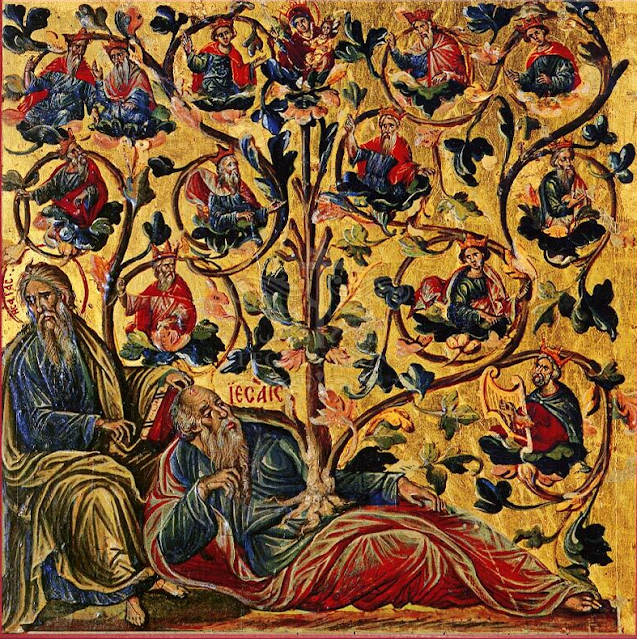
A Jesse Tree icon based on Isaiah: "On that day, the root of Jesse will be a sign for all nations. The Gentiles will look to him, and his home will be glorious." (Isaiah 11:10)
Entering Advent
On the first Sunday in Advent, we cross a threshold into a new liturgical year—Year A, according to the Book of Common Prayer. This season at Harbor, our worship will draw us deeply into the prophetic witness of Isaiah, whose ministry to God’s ancient people carried the strange and beautiful weight of what Fr. Alexander Schmemann called “bright sadness.”
A new liturgical year functions a bit like smelling salts for the church. Advent begins by rousing drowsy hearts, calling us to cast off the works of darkness and to stay awake. Properly understood, Advent is a shock to the spiritual system because it awakens us to hope—real hope, grounded not in sentiment but in the promises of God. This is why the season opens not with the story of Christ’s first coming, but with the blazing promise of his second. We begin with cosmic upheaval, lessons drawn from the fig tree, and a sweeping eschatological horizon. Advent instructs us to live with the end in view, as a people who stand upright with heads lifted high, even as the world trembles with fear.
Marilynne Robinson reminds us, “Fear is not a Christian habit of mind.” If we truly receive the authority of our own Scriptures, she says, we cannot imagine Christ as confined to one moment in time. Instead, we live in joyful expectation of the One who comes to us from the future. As Malcolm Guite writes, the Messiah who was once “folded with us into time and place” will return to “unfold for us the mystery of grace.” Christians, then, are those drawn forward by the future God has promised, not driven merely by the past we recall.
The Meaning of Advent
The word Advent comes from the Latin adventus—“coming” or “arrival.” It is a season of remembering and preparing for Christ’s two comings. We remember Israel waiting in darkness for the Messiah, the Light of the world. And we prepare—along with all God’s people—for the day when that same Light will come again to judge the living and the dead. Advent holds together grace and judgment, longing and fulfillment, the already and the not yet.
Our cultural practices tend to sprint toward December—toward feasting, celebrating, and consuming—often without pausing to watch, wait, or make room for the Light who comes. But the historic Christian practice of Advent begins in the dark. We learn again how to wait so that our Christmas rejoicing may be rooted, deepened, and made whole. If Advent is unfamiliar to you, the resources below offer a gentle entry into its rhythms. May the Spirit of the Messiah consecrate this season for you, making it both holy and joyful.
Advent Books
If you are new to Advent, or simply seeking fresh reading as we begin this new liturgical year, we commend the following books to enrich your reflection and prayer:
Advent Homilies: by St. Augustine
Waiting on the Word: A Poem A Day for Advent, Christmas, and Epiphany by Malcolm Guite.
Sermons on Advent & Christmas by St. Bernard of Clairvaux
Advent: The Once and Future Coming of Jesus Christ by Fleming Rutledge
God is in the Manger: Advent & Christmas Reflections by Dietrich Bonhoeffer
The Liturgical Home: Advent by Ashley Tumlin Wallace
The Dawn of Redeeming Grace: Daily Devotions for Advent by Sinclair Ferguson
Advent: The Season of Hope by Tish Harrison Warren
Advent Music
Advent music is distinct from Christmas music. Perhaps the most iconic Advent hymn is O Come, O Come, Emmanuel, which captures the season’s themes of longing and expectant hope. Christmas music, by contrast, celebrates the joy of Christ’s birth. Hark! The Herald Angels Sing is a classic example. Interestingly, Joy to the World—often sung at Christmas—actually celebrates Christ’s second coming.
To help shape your devotional life this season, we invite you to revisit the Advent music we have historically sung at Harbor through our Spotify channel.
Advent Practices
Likewise, if this is a new season for you, we invite you to explore the practices that have shaped Christians across generations. As a church, we will mark the season with an Advent wreath, lighting a new candle each Sunday. On November 30th, you will have the opportunity to see the wreath in person and join us in this simple yet profound rhythm of watching and waiting for the coming Light.
Keep an Advent calendar
Light an Advent wreath
Do the Daily Office
Advent Guides
Lastly, if you are someone who likes an actual guide-in-hand, we commend the following to you, but highly recommend that you invest in printing these out ($10-$20 of a worthy investment), and not relying on them digitally:
For families with young children, consider the Advent guide from St. John’s Anglican Vancouver — access here.
For individuals, this Advent guide provides a devotional reading and prayer for each day that explores the theme of human fear and how Christ’s peace comes to meet us in it.
For a focused Advent wreath guide (with an additional “O Antiphons” guide), we commend this very short Anglican devotional.
For those fairly new to Anglicanism, this Advent reader from our friends All Saints Honolulu is a great place to start.
